Diving Palau With My Brother: Sharks, Wrecks, and a Reunion
Late afternoon, October 2024. We had just surfaced from a shark-filled drift dive, and the group was talking over each other on the boat. My older brother came up next to me, mask pushed onto his forehead, grinning. We gave each other a high-five underwater.
I have led a lot of dives. I have never led one quite like that. My brother got me into diving back home in Israel, years before it became my profession. Twenty years ago I moved to the United States. He stayed. Since then we have seen each other on short family visits, never for more than a few days, and never in the water.
For his 60th birthday, I invited him to join a group trip I was leading to Palau, my second time there: ten nights, daily diving with Sam's Tours, and the two of us back on the same boat. This is what that trip looked like, dive by dive, and what it turned into.
Getting there
Palau is far from everywhere, and the travel is part of the deal. We flew from Colorado to Los Angeles in the late afternoon, took the overnight flight across the Pacific to Taipei, stretched our legs in the terminal, and connected to Palau. Door to door, it was more than 30 hours.
Arrival in Palau has one detail I always notice. Every visitor signs the Palau Pledge, a promise to act responsibly toward the islands and the ocean during their stay, and it goes into your passport. After 30 hours of airports, it is a good reminder of where you just landed: a country that takes its reefs seriously and has the reef health to show for it.
Our base for ten nights was the Palau Royal Resort on Malakal Island, a comfortable oceanfront hotel a short ride from the dive operator. We checked in late, heard the water from our room, and fell asleep.
A day on the water
Every morning started at Sam's Tours' dock in Malakal Harbor: guides loaded cylinders onto the skiffs, divers applied sunscreen, and the dock dog checked everyone for food. On the first day, I handled the paperwork and Rock Islands permits required to dive most sites. Sam's crew handled the rest. Our gear stayed at their facility all week, set up on the boat each morning, and they had reef hooks for anyone who didn't bring one.
The routine settled in fast. Boats left at 8:00, we made two or three dives, and we were back at the dock by about 4:00. The ride out took 30 to 60 minutes depending on the site, through the Rock Islands: limestone domes covered in jungle, sitting in calm lagoon water protected by the barrier reef. Flying fish broke out of the wake. My brother sat up front the first morning, looked around, and said, "Now this is a proper dive commute."
The guides briefed every dive carefully, and in Palau that matters. Many of the best sites run on current, and the plan depends on that day's tide. Most sites have moorings. We back-rolled in, descended quickly, and on the current dives, hooked in.
Surface intervals happened on beaches. Ulong Island, where the TV show Survivor once filmed, and Two Dogs Beach became our regular stops. One day at Ulong's Activity Beach, we had Palauan lunch: grilled fish, taro, sweet potato, and patties made from taro leaves. We ate in the shade with our feet in warm water between dives on one of the world's best reef systems.
The Cornes
Palau's reputation rests on its corners: points on the outer reef where current wraps around the wall and brings food, and the food brings everything else. Current brings the big animals there. It also means these sites demand good buoyancy, a solid briefing, and a reef hook.
Siaes Corner was our checkout dive, and it set the tone. We dropped onto the wall and let a mild current carry us along a fish-filled slope. Within minutes, two grey reef sharks came in to look at us. As we rounded the corner, the current picked up. We hooked into rock at about 50 feet and watched sharks, jacks, and barracuda work the reef edge.
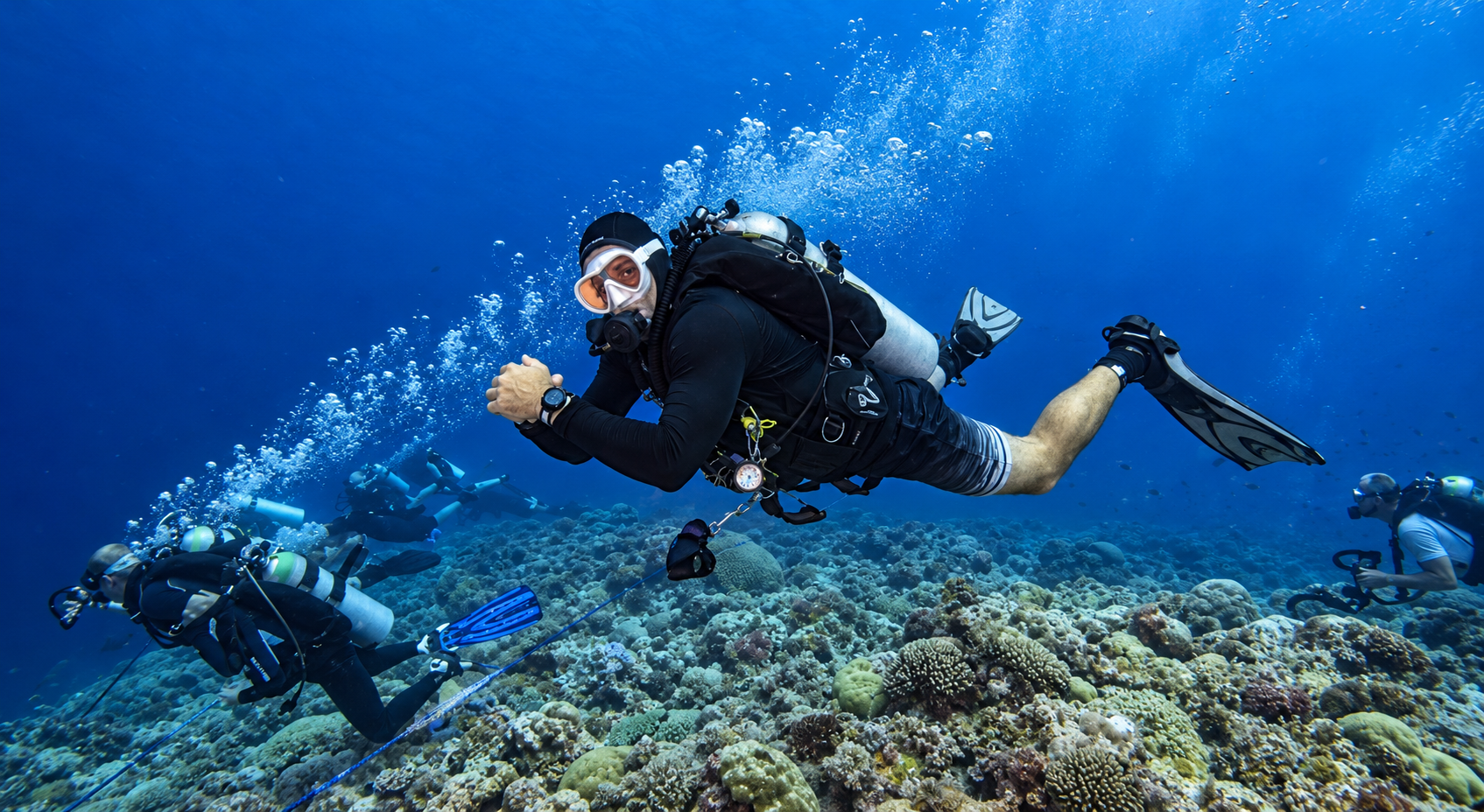
Over the next days, we dove New Drop-Off and then Blue Corner, the most famous site in Palau. I had dived it on my first trip, and it has never disappointed me. We finned along a wall covered in soft corals and sea fans. As we approached the plateau, the current went from a push to a real pull. The guide signaled, and we each found dead rock to set our hooks, then rose on our tethers and settled in.
What followed is why people fly 30 hours. Grey reef and whitetip sharks cruising a few feet away. A tight school of bigeye jacks turning in the current. Barracuda holding further out. A Napoleon wrasse the guides know well came straight up to one of our divers and nearly took his regulator. At one point, a group of eagle rays passed overhead while a shark darted in and took a fish, and the whole reef reacted at once.
My brother surfaced from that dive with his eyes wide open. "I've never seen anything like that," he kept saying. This is the man who started my diving life. Watching him come up from Blue Corner like a new diver was as good as the dive itself.
Blue Holes sits right next to Blue Corner, and on one morning we dove them as a single combination dive. Four openings in the shallow reef top drop into one large chamber, with light coming down through the holes. The cavern is wide and open, about 80 feet deep, with a school of snappers holding in the blue light. We exited through the opening in the wall and drifted straight onto Blue Corner for a second round of sharks. Two signature sites, one dive.
Channels and walls
Ulong Channel is a fast ride. We timed it on the incoming tide and flew over a sandy channel floor dotted with lettuce coral formations the size of tables. At the mouth of the channel, groupers and snappers gathered in numbers. Ulong is known for spawning aggregations around the full moon. We timed it wrong for that, but the schools were still impressive.
German Channel is a cut through the reef made during the German colonial period, more than a century ago, and it is best known for manta rays visiting cleaning stations. We knelt in the sand near a station and watched the cleaner wrasse working the coral heads, waiting for a manta. None came that day. The dive still gave us garden eels rising from the sand and a large marbled ray gliding past. Mantas are never guaranteed, and I would rather tell you that than promise them.
Dexter's Wall was the trip's surprise. It gets less attention than the corners, and it was full of green turtles: some asleep under overhangs, some feeding calmly on the wall. One stayed alongside our group for a long stretch, as if showing us around. After the intensity of Blue Corner, it was a slow, easy dive, and it became one of my trip's favorites.
Turtle Cove starts with a small cavern opening on the reef top and leads out to a rich wall. The turtles were there, as the name promises. So was an octopus, wedged under a ledge. We hovered back and watched it change from mottled brown to nearly white against the coral, slide out, and pour itself into a new crevice.
White Face takes its name from a pale limestone cliff above the site. Underwater, it is wide fields of plate coral and schools of pyramid butterflyfish feeding on plankton. We drifted the wall in mild current, slow enough to take in the coral.
The quiet dives
Not every good dive in Palau is a current dive. On calmer days, or for the third dive, we went inside the lagoon.
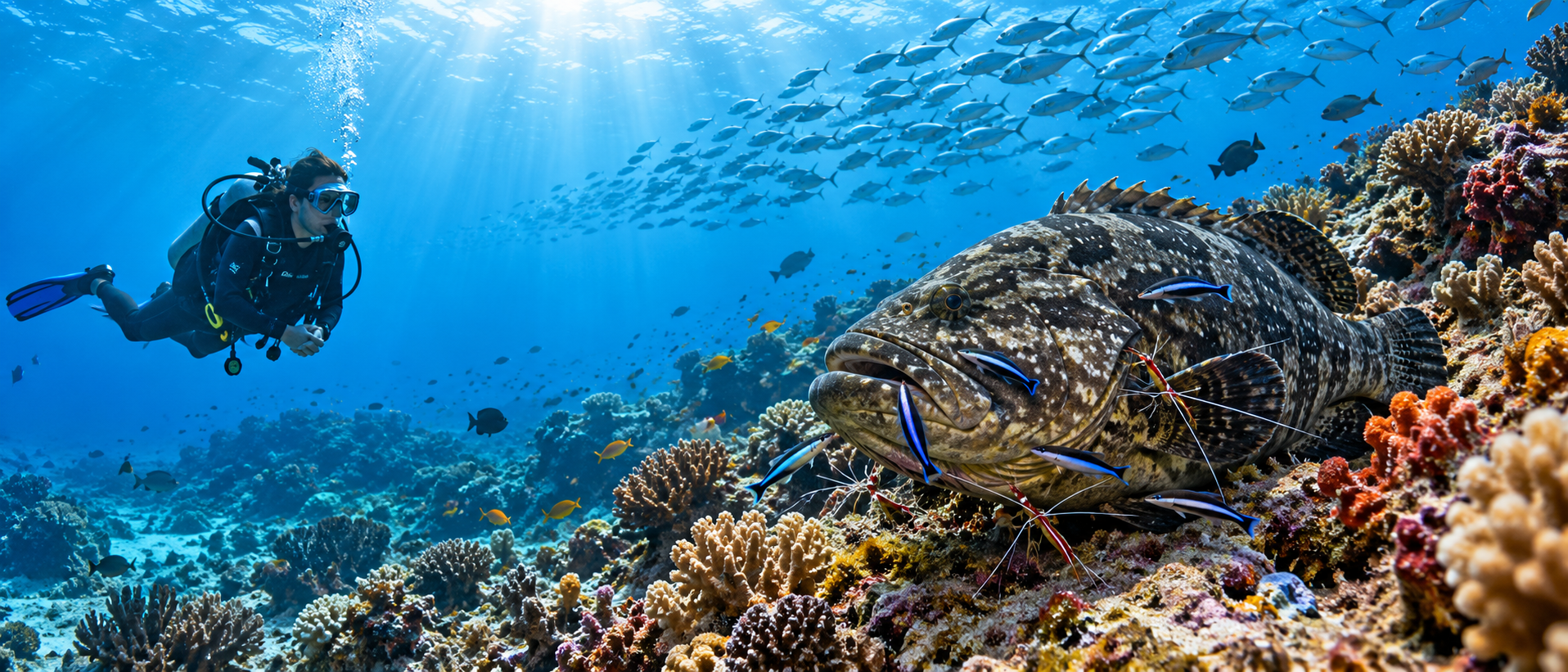
Ngerchong Inside, a protected coral garden on Palau's east side, was one of the healthiest hard-coral reefs I have seen anywhere. Staghorn thickets, brain corals, cabbage corals, all intact. We stayed around 30 feet and took our time: scorpionfish hiding in plain sight, anemonefish in their hosts, a giant clam with a bright blue mantle, Christmas tree worms snapping back into the coral as we passed, and a hawksbill turtle working the sponges. Without current, you see the details.
Lighthouse Reef, near Koror, is a sloping reef we dove in the afternoon with low sun angling in. Butterflyfish and anthias over the coral heads, and bommies covered in cleaner shrimp. I held out my hand at one, and a banded cleaner shrimp climbed on and started working on my fingers. Our guide also found a frogfish that looked exactly like a sponge. I still don't know how they spot them.
Sandbar is a shallow sandy area inside the lagoon, and we went for one reason: mandarin fish. At dusk we settled near the coral rubble and waited. As the light went out, several came out, and the males began displaying to the females. With patience, we watched a pair rise together off the bottom to spawn, from start to finish in a few seconds. As full darkness came, small bioluminescent crustaceans began flashing in the sand around us.
the wrecks
In March 1944, U.S. carrier aircraft attacked the Japanese fleet anchored around Palau in an operation called Desecrate One, and dozens of ships went down in these lagoons. Today those wrecks are reefs.
The Iro Maru was the standout. She was a Japanese fleet oiler, and she sits upright, with her deck at about 80 feet and the seabed at about 130 feet. We came down the mooring line, and the ship's shape filled the water below us. We started at the bow, where coral-covered guns still point up, now sheltering small fish. Along the deck, soft corals moved in the current, lionfish hung under ledges, and big groupers moved around the superstructure. With lights, we looked into the holds at drums and machinery, covered in rust and sponge. At the stern, the tall kingposts are covered in yellow soft coral, the shot every photographer on the boat wanted. A hawksbill turtle slept on the wreck, unbothered by it all.
The Chuyo Maru is a cargo ship known locally as the Lionfish Wreck, and it earned its name. Her deck sits around 90 feet. A cloud of anthias hung over the wreck as we descended, and lionfish were everywhere on the deck, fins spread. A moray watched us from an opening. Our guide pointed into the holds at old tires and machinery from the cargo she carried. We stayed outside: the interior silts easily, and not everyone in the group was wreck-trained. Circling her was more than enough.
The Hafa Adai is a younger wreck, not from the war, and a good macro dive. Nudibranchs on the rails, jawfish hovering over the rubble, black coral on the mast, and schools of glassfish that opened and closed around us as we swam through. The wrecks hit my brother and me differently than the reefs. We both served in the military, and diving ships sunk in a war is not abstract for either of us. After those dives, he was quieter than usual. So was I. It is something to see a place of destruction, over 80 years later, turned into one of the richest habitats on the reef.
Between the dives
The hours out of the water shaped this trip as much as the dives did. At Two Dogs Beach, a small cove named for two odd rock formations, the tide was out one day and a sandbar stretched into the lagoon. A few of us waded out to our knees, and young blacktip reef sharks, one or two feet long, circled our legs looking for scraps, completely unconcerned with us. Back on the sand, the boat captain had opened a coconut and was passing pieces around. Hermit crabs moved through the leaves, and fruit bats hung in the trees.
Near Ulong, we climbed a limestone outcrop to find an old Japanese gun from the war, hidden in the jungle. Palau's wartime relics turn up in unexpected places. At Milky Way, a cove with a bottom of fine white limestone mud, our guides had us scoop it up and cover ourselves. It is a tourist ritual and a little silly. We all did it, laughed through it, rinsed off in the lagoon, and loved every minute.
The rides home were their own reward. One late afternoon the lagoon went completely flat, and the Rock Islands reflected in the water like a mirror. The whole boat went quiet. My brother leaned on the bow rail with his eyes closed and the wind in his face. That picture of him is one I will keep.
Evenings meant food and stories. Our group's favorite was The Taj, an Indian restaurant in Koror that would hold its own in any big city. Kramer's Café and Drop Off Bar & Grill, near Sam's, were our regular casual stops, with fresh fish, cold Red Rooster beer from Palau's local brewery, and the dive boats coming in at sunset. On our non-diving day we had a long lunch at Barracuda Restaurant, which suited the vegetarians in our group well. And on one evening we went to Elilai for my brother's birthday dinner. I had quietly told the staff. They brought out a dessert with his name on it and sang, and he was moved, and so was I.
Koror is small and easy to walk. My brother bought a storyboard, the carved wooden panels that tell Palauan legends, to take home. We spent an afternoon at the Belau National Museum, which covers Palau from its early history through the Spanish, German, and Japanese periods and the war. On early morning walks I passed kids in school uniforms and fishermen selling the night's tuna and wahoo by the road. We learned two words of Palauan, alii for hello and sulang for thank you, and used them everywhere. They always earned a smile. The respect for nature you sign in the Palau Pledge is real here. You see it in how people live.
the lake we skipped
One famous Palau attraction is missing from this story: Jellyfish Lake, a marine lake cut off from the ocean where golden jellyfish with very weak stings live in huge numbers. It is snorkel-only. Scuba is not allowed in the lake.
The lake has had a rough decade. After a severe drought in 2016, the jellyfish population collapsed, and the lake was closed for about two years to let it recover. It reopened around the start of 2019, with numbers rebounding but well below their old peak.
We chose not to go. Part of it was time: this was a dive trip, and every day we spent on a snorkel tour was a day off the outer reef. Part of it was the lake itself. It reopened with careful rules and a guided visitor program, but the population was still rebuilding, and I preferred to give it more time. A few people in the group were disappointed, and I understood. Jellyfish Lake will still be there. It is on the list for next time.
Twenty years
The year before this trip, our mother died. My brother carried most of that weight at home in Israel while I was an ocean away. It made something clear to me: I missed him, and I wanted to share the biggest part of my life with him again, the way we did when we were young. Palau was the invitation.
It started on the flights, long hours of talking about childhood, our parents, and what comes next. But it settled underwater. Diving is my profession. I usually dive with students and groups, watching everyone else. On this trip, my brother was my buddy. At Blue Corner, hooked in with sharks all around us, I looked over at him. He gave me an OK sign and then did a small, ridiculous dance on his tether. I laughed into my regulator. For a moment, we were two kids again, sharing a private joke.
One night, after the Blue Holes and Blue Corner day, we sat on the hotel dock with our feet in the water and a last beer. The moon was on the lagoon. We didn't talk for a while. Then he said quietly, "Mom would have loved hearing about this."
That opened the conversation we had both been avoiding. We talked about her. We cried a little and held each other. I told him how grateful I was for everything he did for the family while I was far away. He waved it off, as he always does, but I think he was glad to hear it.
After that night, something was easier between us. We joked more, and we were comfortable in silence. During one surface interval, while the group talked around us, we sat back and passed a bag of dried mango between us without saying a word. We didn't need to.
On the last dive of the trip, I let him and the guide move ahead and hung back to watch him. He was peering into a crevice, looking for something small, completely in his element. As a trip leader, my job is to give other people a great experience. This time, the ocean gave me one.
When we packed our gear on the last day, he grinned and asked, "So where are we going next year?"
how we run it
Palau rewards planning, and it punishes the lack of it. A few things made this trip work:
• One operator, all week. Sam's Tours handled every dive. Our gear lived at their facility,
permits were done on day one, and the guides knew both the sites and our group by the second morning.
• Nitrox on every dive. Everyone breathed 32 percent, with computers set to the mix. Our dives rarely came near the nitrox limits, so the lower nitrogen load stayed as margin, and on repeated days of diving at depth, that margin matters.
• Small groups per guide. We ran about six divers per guide, which in strong current is the difference between a guided dive and a crowd.
A mixed group, handled honestly. Our divers ranged from about 20 logged dives to more than 1,000. The guides matched sites and timing to experience. Newer divers did the calmer sites on the days the currents were running hard, and nobody was put into currents they weren't ready for.
•
Room for non-divers. One spouse in our group didn't dive. She split her days between the snorkel tour, the museum, and the spa, and went home as happy as anyone.
In April 2026, I went back a third time with a Bluebound group and built that trip on what we learned from this one.
until next time
On the last morning I got up early and watched the sun come up over the lagoon. The gear was packed and the logbooks were full. We came to Palau for sharks in current, healthy coral, and wrecks from the war, and Palau delivered all of it. I left with something I didn't plan for: my brother back.
As we flew out, I could trace the boat routes below through the islands: Blue Corner over there, the beach at Ulong, the lagoon that holds the Iro. Palau has more to show than one trip covers. Peleliu, with its war history and harder current dives, is still on my list, and so is Jellyfish Lake.
As for my brother's question, I don't have the answer yet. I only know it won't take another twenty years.
palau FAQ
- When is the best time to dive Palau? Palau dives well all year. November through April is generally the preferred window, with the calmest seas, and October and May are often good too. June through September brings more rain, and wind and swell can limit access to the outer reef. Water runs about 81 to 86°F, and outer-reef visibility is often 65 to 130 feet. We went in October and had excellent conditions, with some rain, mostly at night.
- How much experience do I need? Palau's signature sites run on current. Blue Corner, Siaes, and Ulong Channel require solid buoyancy, comfort with drift diving, and a reef hook, often at 60 to 100 feet. The Iro Maru's deck sits around 80 feet. I strongly recommend Advanced certification, nitrox certification, and some drift diving before you go. Calmer sites likeNgerchong Inside and Lighthouse Reef give newer divers plenty to enjoy, and good guidesmatch sites to the diver.
- How do you get to Palau? Most routes from the U.S. connect through Guam or Taipei. We flew from Colorado to Los Angeles to Taipei to Palau, more than 30 hours door to door. Flights don't run daily from every hub, and schedules change, so plan your dates around them. And plan 24 hours between your last dive and your flight home. On our trips, that's a rule.
- What rules should divers know? Every visitor signs the Palau Pledge on arrival. Divers need a Rock Islands permit, which your operator usually arranges; keep it with you, because rangers check. Palau banned reef-toxic sunscreens, including oxybenzone and octinoxate, in 2020, so bring a reef-safe product or cover up with a rash guard. Don't touch the reef, and don't take anything out of the water.
- What gear should I bring? Bring your own dive computer, a reef hook, and a surface marker buoy. In current, an SMB is not optional. A 3mm full suit was right for me in the water in the low to mid 80s. Bring your nitrox card. Booties and open-heel fins help on rough entries.
- Is there enough for non-divers? Yes. A Rock Islands snorkel tour covers Milky Way and shallow reefs, and Jellyfish Lake when it's open (snorkel only, with a licensed guide). There'sthe Peleliu war history tour, the Ngardmau waterfall hike on Babeldaob, and the Belau National Museum in Koror. The non-diver in our group never ran out of things to do.
Recent Posts